
The Bible is not a Christian book. The Bible is a collection of 66 books, 39 of which were not written by Christians. They were written by Jews. So when we read those 39 books it is very easy to read it first as Christians (in light of the 27 Christian books we call the New Testament) rather than as the Jewish authors understood what they were writing. When we read any portion of the Bible, we have to keep in mind that it was God’s Word to someone else long before it was God’s Word to us, so to understand how it is God’s Word to us we have to try to understand it as it was intended to be understood by the original audience. Reading the Bible is, in a very real sense, reading someone else’s mail. If you opened your neighbor’s mail and found a check from the government, you wouldn’t try to cash it. However, the fact that your neighbor got a check in the mail from the government tells you something about the government.
For example: In Jeremiah 29:11 God says to Jeremiah “I know the plans I have for you, plans to prosper you and not to harm you, plans to give you a hope and a future.” Wonderful words….wonderful words spoken to the man Jeremiah. God did not speak those words to Michael Durso. Or when God says in 2 Chronicles 7:14 “[if] (a word brought in from verse 13) my people who are called by my name humble themselves and seek my face and turn from their wicked ways, then I will hear from heaven, will forgive their sin and will heal their land,” God did not speak those words to American Christians, but to the Jewish nation under the Sinai Covenant in which blessing for obedience and cursing for disobedience were promised. That verse is the second half of a promise in which God says that if His people reject Him and disobey, and He punishes them in discipline so that they turn back, He will heal and forgive them. But the fact that God made that promise to Israel tells us something about God and His character, even though that promise was not made to us western Christians. For a fuller article on the misuse of 2 Chronicles 7:14, see my blog post on it here.
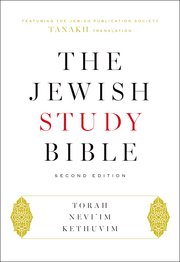
That is the way we have to read the Bible, particularly the Old Testament. Today I want to recommend something that may help. The Jewish Study Bible, 2nd Ed, published by Oxford University Press, originally in 2003 but updated in 2014. This study Bible was put together by the Jewish Publication Society, the oldest nonprofit publisher of Jewish works in the world (est. 1888). The Bible version used in this study Bible is JPS’s own version, referred to as NJPS. The NJPS is a conservative translation of the Hebrew Bible that was pieced together over 30 years and originally published in 1985. It reads a bit different than your typical English Bible most evangelicals are used to reading.
The layout of the Bible is in the traditional arrangement of books in the Hebrew Bible. It therefore is divided in three sections, Torah (Law/Instruction), Nevi’im (Prophets), Kethuvim (Writings).
Here’s what this looks like:
Torah (Law/Instruction): Genesis, Exodus, Leviticus, Numbers, Deuteronomy
Nevi’im (Prophets): Joshua, Judges, 1-2 Samuel, 1-2 Kings, Isaiah, Jeremiah, Ezekiel, The Twelve (Hosea, Joel, Amos, Obadiah, Jonah, Micah, Nahum, Habakkuk, Zephaniah, Haggai, Zechariah, Malachi)
Kethuvim (Writings): Psalms, Proverbs, Job, The Five Megilloth [Scrolls] (The Song of Songs, Ruth, Lamentations, Ecclesiastes, Esther) Daniel, Ezra, Nehemiah, 1-2 Chronicles.
Quite a bit different from how our modern English Bible is laid out.
As a study Bible it comes with essays to introduce each of the three major sections of the Bible, and essays to introduce each book. It also has a multitude of study notes written from a variety of different perspectives within Judaism. As it is pointed out in the main introduction, “There is no official interpretation of the Hebrew Bible,” so there are many perspectives appreciated and represented by the different contributors.
The main reason a Christian can benefit from reading a Jewish study Bible is that you get to read and hear the interpretation of the Bible through the lens of Jews as it was written. When the Messiah came on the scene of human history, He obliterated a number of misconceptions about Him. His ways were unprecedented, and that is nowhere any clearer than when reading how Jews understand the portions of the Bible that deal specifically with Jesus.
For example, the oracle of the Suffering Servant in Isaiah 53 depicts a man representing Israel who suffers for Israel to heal them and reconcile them to God. The study note for verses 4-6 says:
“Either the servant suffered on behalf of the speakers (i.e., the guilty were not punished at all), or he suffered along with the guilty, even though he himself did not share in the guilt of his fellow Israelites. The former idea (i.e., the notion of vicarious suffering) would be unusual for the Bible; the latter idea (the idea of corporate guilt) is not.”
What is unprecedented about the ways of Jesus the true Suffering Servant is what these Jewish scholars insist should not be expected from the Bible. He did indeed suffer vicariously in their place to spare them. That is what Jesus did. So the benefit to reading the Jewish perspective is it helps us rejoice in the surprise of the Gospel. God did the unthinkable when He, in the lyrics of Andrew Peterson, “Took on the flesh of a man and walked in my shoes through the shadow of death.”
Other benefits of reading the Jewish Study Bible are in greater detail on Jewish festivals and laws, and other issues we have a hard time appreciating when we read the Old Testament as Christian literature.
Disclosure of Material Connection: I received this book free from the publisher, Oxford University Press. I was not required to write a positive review. The opinions I have expressed are my own. I am disclosing this in accordance with the Federal Trade Commission’s 16 CFR, Part 255 <http://www.access.gpo.gov/nara/cfr/waisidx_03/16cfr255_03.html> :
 Michael Durso Blog