
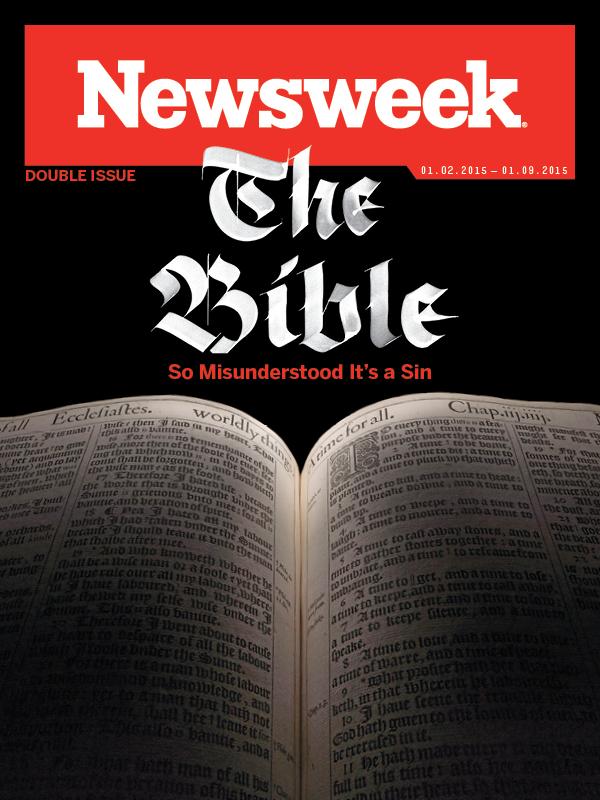
No television preacher has ever read the Bible. Neither has any evangelical politician. Neither has the pope. Neither have I. And neither have you. At best, we’ve all read a bad translation—a translation of translations of translations of hand-copied copies of copies of copies of copies, and on and on, hundreds of times.[1]
As you may have seen, this paragraph comes from an article published recently in Newsweek Magazine. I won’t belabor the points already made by several others (points you can go read yourselves), that this article is a fairly blatant, open attack against evangelical Christians—but I wanted to take this opportunity to give some answers to what may be a question this raised for some of us. How did we get the Bible? Is it really as the Newsweek author said, that we have copies of copies of copies, “playing telephone with God’s word?”
As Albert Mohler, president of Southern Baptist Theological Seminary in Louiville, Kentucky has said, “That’s not even close to being true. We have very accurate translations available to us now, based upon very credible texts. That’s not really the problem. We have a very credible access to translations of the Scripture.”[2]
So how is that? What can we look at to understand how and why the texts we have are credible, and how do we know our translations are accurate? How do we know we can trust the Bible in the midst of so many screaming that we can’t and that we are somehow major fools for doing so?
This, in part, is a faith question; if God is willing and able to send His Son into this world and keep Him from corruption during His earthly life, is He not also willing and able to put His written Word into this world and keep it from corruption for our benefit? If God gave us the Scriptures, would He not have the ability to maintain its integrity and reliability so that God’s will for us is never in question?
Of course, this type of answer is almost always slammed as just circular reasoning: “The Bible is true because the Bible says so.” Well, sort of. I could argue that the objection itself is also circular reasoning because the person is relying on their own ability to use logic which he has no ground in claiming apart from the existence of God. To put it another way, telling a Christian to defend God’s Word without appealing to God’s Word is the same as telling the skeptic to defend his reasoning without appealing to his reasoning. It’s all circular. They are both faith commitments. However….very big HOWEVER…there are real, historical evidences for the reliability and accuracy of the Bible being ignored by the authors of such articles as Newsweek just published.
The following is by far not exhaustive, but is a list of a few of the best reasons in my opinion why the Bible-slamming in Newsweek does not stand. Here are some things to consider that support what our faith already tells us, that the Bible is accurate and trustworthy. You really, truly can trust your Bibles. Here’s some reasons why:
- Stay tuned as I complete this blog post. I will re-post when finished. I hope that’s not too disappointing…just want you to know what’s coming. 🙂
[1] http://www.newsweek.com/2015/01/02/thats-not-what-bible-says-294018.html
[2] http://insider.foxnews.com/2014/12/30/hit-piece-bible-newsweek-slammed-open-attack-christians
 Michael Durso Blog
[…] but is a list of a few of the best reasons in my opinion why the Bible-slamming in Newsweek (see yesterday’s post) does not stand. Here are some things to consider that support what our faith already tells us, […]
LikeLike