
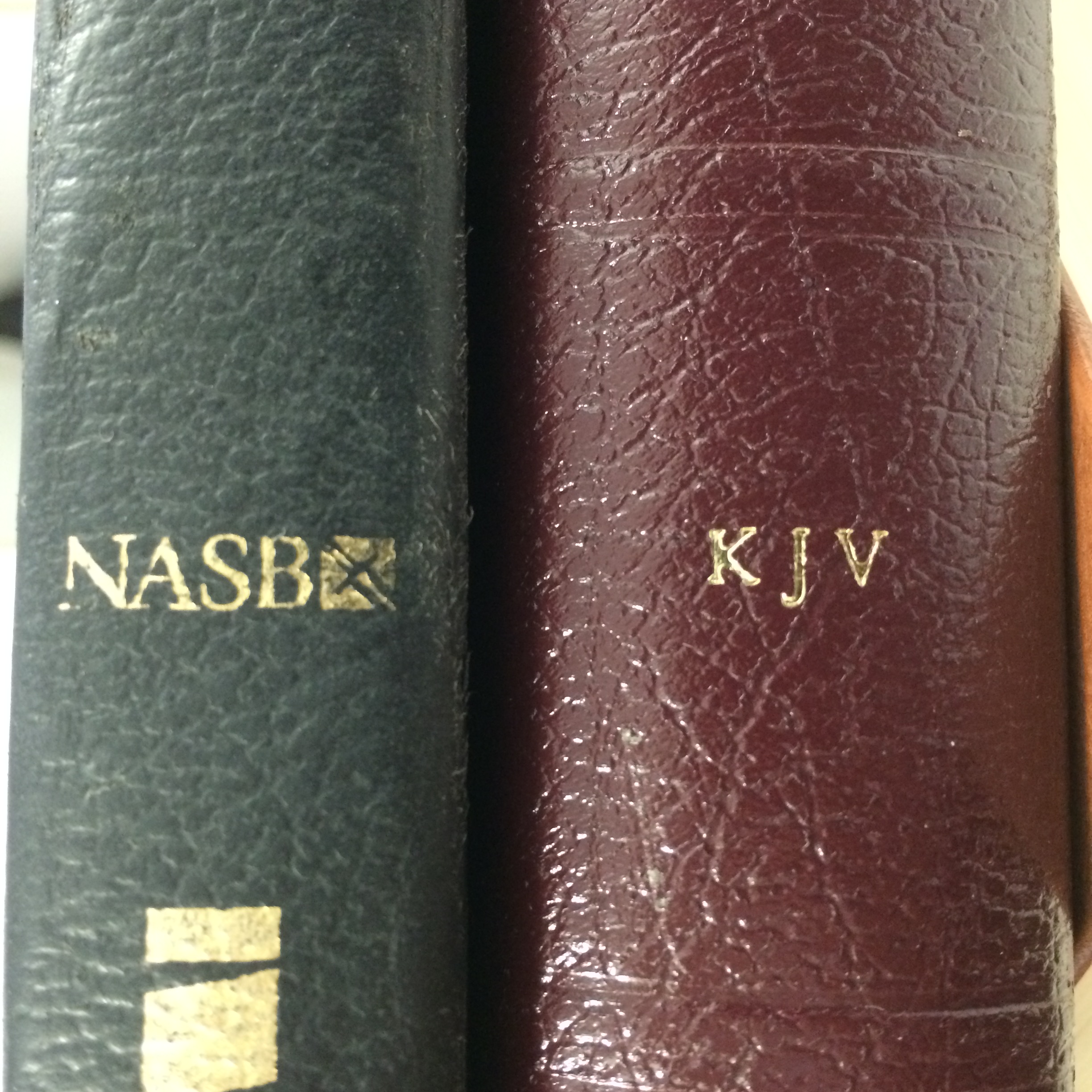
What do you do when you read two versions of the Bible next to to each other, and you come across a verse that is translated totally different in the two versions?
Imagine you’re one of the majority of Bible readers in America who either still stick to, or at least grew up on, the King James Version of the Bible. (While the NIV is the most purchased Bible, the KJV is the most read hands-down.) Imagine once upon a time you memorized some verses of Psalm 8 in KJV….
What is man, that thou art mindful of him?
And the son of man, that thou visitest him?
For thou hast made him a little lower than the angels,
And hast crowned him with glory and honour.
(Psalm 8:4-5)
This is an amazing Scripture. The almighty God of the universe made us a little lower than angels and yet crowns US with glory and honor?? If you really grapple with that thought, it should lead you to worship the Almighty.
But then one day you hear a pastor or a professor or friend recommending the New American Standard Bible, saying it is the most literal translation in modern English (because let’s face it, Elizabethan English is not our language anymore). It’s based on supposedly better manuscripts (scores of older manuscripts have been found since the KJV was translated in 1611), and should therefore be more accurate.
So you get yourself an NASB, and flip to something familiar, Psalm 8, and you find this:
What is man that You take thought of him,
And the son of man that You care for him?
Yet You have made him a little lower than God,
And You crown him with glory and majesty!
Compare “Thou hast made him (man) a little lower than the angels” with “You have made him a little lower than God.” That’s a pretty significant difference, yes? So is man made a little lower than angels, or a little lower than God? This passage is quoted elsewhere in the Bible. In Hebrews 2:6…quoting from the NASB here…it says “You have made him for a little while lower than the angels.” So, it appears the NASB has really missed the mark here. Even when it quotes from this verse in Psalm 8 it reflects the KJV’s translation of the Psalm. So what does this mean for the accuracy and reliability of the NASB?
In short, nothing. Despite the many detractors who see this and raise the satanic-corrupt-text flag, it means absolutely nothing, and I’ll show you why, and it has nothing to do with differing manuscripts. In fact, when you look into the manuscript information in a critical text of the Hebrew Bible, there exists no footnote, no different data, no suggestion of an emendation of the text. The NASB is translated from the same Hebrew words–the exact same words–as the KJV was. So why the difference?
The Hebrew text of the first line of Psalm 8:5 is comprised of three Hebrew words, |and/yet You made him lacking/diminished | a little | than/from ʾĕlōhîm |. Elohim is the plural form of the Hebrew word for “god,” ʾĕl, or El. Whenever you see “God” written as a proper noun in the Old Testament, it was translated from Elohim, a plural form, normally meaning “gods.” When reading Hebrew it becomes a little difficult at times to decide between “God” as a proper noun, and “gods” because the two are the exact same word in Hebrew.
In the context of Psalm 8, it is most likely that Elohim here refers to “heavenly beings” in a general sense (see both NIV and NET Bible’s “heavenly beings”). The NASB (and RSV/NRSV) is translating this in a pretty standard way, rendering God from Elohim. So the real question is where did the KJV translators get “angels” from? As it stands, it isn’t difficult to see “angels” being the translation of “gods” referring in general to heavenly creatures…mankind is made lower than those in that realm. That much is true and makes sense.
But before we end it there, there’s more to the story…Let’s go back to Hebrews 2:6, where the translation is “angels.” The Bible of Jesus, the apostles, the early church, etc., was not as we have it today….they predominantly read the Old Testament in its Greek translation, called the Septuagint. Why this is significant is because almost every time the New Testament authors quote from the Old Testament, they are not quoting from a Hebrew text, but a Greek text. They are not quoting from the Hebrew Bible, but from its Greek translation, which is not an inspired text…this is an exercise for us in trusting the sovereignty and wisdom of God, isn’t it? The Septuagint reads ἀγγέλους, “angels.” So when the KJV translators compared both Psalm 8:5 and Hebrews 2:6, it made the most sense to translate “angels” from Elohim, even though Elohim literally means “gods,” and most often refers to God.
So which translation is valid? Both translations are technically valid, one leaning more toward a literal rendering of the Hebrew, and one taking the context more into consideration. Having said that, a compelling argument can be made for the NASB being correct. The Apostle Paul says that believers will judge angels (1 Cor. 6:3), and in Hebrews 1:14 it says that angels were made to be “ministering spirits to those who will inherit salvation.” So we could argue (and I lean this way) that “made him a little lower than God” is the correct translation because angels are serving spirits, they do not have authority over us, although they are more powerful than us. Either way is possible, and neither way is better or worse than the other way. Honestly, not a lot of practical difference comes out of the difference.
Here’s the most important question…which translation is theologically correct? Both. Did God make mankind lower than heavenly beings? Yes. Did God make mankind lower than Himself? Yes. So even though there is a difference in translation, the two are not contradictory. Neither will lead anyone astray. Both versions are faithful and good.
 Michael Durso Blog
Thanks, and I like the clarification you gave. I think for that average reader who needs good understanding (ok, I will say for me since I cannot speak for others lol), I like to have at least 2 versions to compare. A study bible is important to help break down or to shed more history on something. I think we should all have a KJV. As a kid I tried to read the old KJV without study notes. I grew up not going to church or anything but had a devout grandmother who at least made sure I had a bible and I know she must have prayed for me. (I am so grateful for that and wish she were here for me to talk to and ask her questions. ) In my early 20’s a woman stopped by my house and asked me about the Lord. She came by a couple of times and brought me a study bible. New American Standard by Ryrie. For the first time I could read and understand. Years later I bought an NIV Life Application study bible and could get even more understanding. I completely fell in love with the word of God. I don’t like the NLT or Message or any that are more simplistic than what I have because I think they lose to much. I like to read text in NIV and then read it in KJV. Get the differences and understanding. Maybe if I only read it in KJV I would get zero understanding but reading in something easier first then seeing in the KJV I can see it clearly there also. I think my favorite is the NASV that I received from the lady who came to my home out of the blue all those years ago. It has the beautifully written poetic sound to it without as many thee’s and thou’s, for easier reading and understanding. First people need to get one they can read then as they grow they can compare and learn more. My mom is now 70. She finally began going to church with me 2 years ago. She told me she wanted to get a bible with bigger print. (I knew the one she had was a basic bible KJV…old, 60 years probably and rarely opened and forget about study notes), I read a little of one of mine to her. I read the other version to her. I explained the study notes. I told her I would happily buy her a large print bible. She certainly wanted the NIV. She didn’t know there was such a thing. God is amazing! At 69 my mom began reading that bible I got her. I thought maybe she really only wanted it to carry to church, but to my amazement she has read the heck out of it! I was at work one day and she sent me an email (she normally does not do that), she had finished with Revelation (surprised me that she read that and it did not scare her to death)….do you know what she said? “Just finished reading Revelation and WOW, isn’t it going to be wonderful! ”
Praise God! Honestly, I never thought I would see her change like she has!
I think the ONE verse that has stood out to me as reading differently and affecting how I understood it was Genesis 1:14. To me the NIV leaves out some understanding which I just recently found and had a WOW moment and new understanding. Get something you can read and understand and then compare and read side by side!
LikeLiked by 1 person
By the way, I had just ordered a Septuagint about a week ago and am waiting on its arrival. Something else to compare things to. I so many things like that, I believe my husband thinks I am nuts. Who cares right?
LikeLiked by 1 person
Cool. Are you going to try to learn Greek then, or is that an English translation of it? If so, which one?
LikeLiked by 1 person
It is English translation but I think if I am remembering correctly it has both t he Greek and English side by side.
LikeLike
Ok…looked up the one I purchased and I think I spoke incorrectly about it having both Greek and English. I must have mixed it up. I research so many before buying. I ordered the Researchers Ancient Texts volume 3.
LikeLike
Here is an online option as well: http://www.apostolicbible.com/text.htm
LikeLike
Thanks.
I like to use biblehub a lot to compare things and to look at original meaning of the particular translated word.
Is that a good site in your opinion?
LikeLike
I have used it…been a few years, though. I have always heard good things about blueletterbible. I use a lot of different tools, mostly in Logos Bible Software. There are many options now for electronic Bible study tools. Logos, Bible Works, Accordance (for Mac), Olive Tree, and the free program E-Sword, which I do recommend if there isn’t a budget for Bible study tools.
LikeLike
Amen..I also use Logos,e-sword, blue letter. Some work well on the phone some are better on my iPad and others on the laptop. Depends on what I am using at the time and then I love to have the actual book to refer to in hardcopy. Never know when we may not have our electronics. Ha
LikeLiked by 1 person
These days I find myself using less tools and using just a bible in my hand, and preferably not a reference Bible. The ESV, while not my favorite version, has a readers edition which has all reference material removed except chapter numbers. I hope to get one one of these days. There is no concordance, no footnotes, no cross references, and no verse numbers. Single paragraph page formatting. It is beautiful. It reads the way a book should read, which I think is half the battle with trying to understand the Bible. If we can read it as a book, as literature, before we bring our theology to the text, we will be far better off.
LikeLike
Yes, I do find myself ‘recently ‘ reading and writing my thoughts out and then find myself sometimes looking at the notes within to see that often they worked together. I do find myself taking regular words that we often assume we know the meaning of and after looking deeper into the definition I get a deeper understanding of the scriptures meaning. I love that! Have a great day sir!
LikeLiked by 1 person
I like e-sword and I think it’s a great tool for those who can put it on their computers.
LikeLiked by 1 person
Pastor; IMHO,the key statement in your thought provoking post is “They are not quoting from the Hebrew Bible, but from its Greek translation, which is not an inspired text…” What does and does not constitute inspired text is a question that has had significant implications (to say the least) concerning Christian unity (or lack thereof). My post “Versions and Views” @ whichbiblewhatfaith.wordpress.com is a brief attempt to confront these implications, which have historically had such a negative impact on the peace and integrity of the Church.
C.J. Cameron
LikeLike
This is something that allows us to see why God did not allow original autographs to survive. We come so close to worshiping translations….we fight over translations and manuscripts…my word, what would we do with King David’s original Psalter?? Versions is such a divisive issue, which is why I choose to write along this vein of showing that even when differences exist, it is only what we bring to the argument that changes things. This post is primarily a response to a YouTube video of a man quite arrogantly slamming the NASB primarily because of his presupposition that the King James Bible is basically an inspired translation. He used the word “perfect” to describe the KJV, which should only be used for God’s inspired Word, which we do not technically have in its physical form. The point of text criticism is to determine which texts accurately represent God’s Word…and it is very very accurate in pretty much any version we read. It is sad this is such a divisive issue… I suspect we fight over God’s Word because we fail to do his word. If we were busy fighting the good fight, we would not be busy fighting this one.
LikeLike
I like the KJV of all translations. I can’t use the NIV – Actually, It has removed some verses and redefined others. Sooo sad!
LikeLike
I can’t agree with that statement historically…”removed some verses” could only be true if the NIV was a re-translation of the KJV. That said, I’m not a fan of the NIV either. 🙂
LikeLike
I wish I could share wit you some verses right now. May be I will someday. Have a blissful day.
LikeLike
I hear you. I’ll say, though that showing me verses wouldn’t really matter because, like I said, the claim assumes the KJV is the perfect standard for the Bible from which all other translations must be based off. The NIV translation committee could not have removed verses and changed things if they weren’t using the KJV as their basis, but using Hebrew, Aramaic and Greek manuscripts. The reason they’re different isn’t because of bias or conspiracy, but simply because they used an eclectic set of over 5,000 manuscripts, most of them much older than the 5-7 manuscripts used to translate the KJV. I am quite happy to talk about it, but showing me verses just isn’t going to matter. You have a great day as well. 🙂
LikeLiked by 1 person